
Tomato and Tofu Soup (番茄豆腐汤)
番茄豆腐汤 · fān qié dòu fu tāng
The first soup I learned to cook on my own: nothing can really go wrong, and it tastes like something you would order. It is still what I make when the fridge holds only tomatoes and a block of tofu.
Recipe author: HǎoWèi Test Kitchen
Home-cooking research team
Reviewed by HǎoWèi editorial team · Last updated 2026-08-29
Ingredients
- soft or medium tofu, cubed嫩豆腐/中豆腐(切块)🛒 local350 g
- ripe tomatoes, cut in wedges成熟番茄(切块)🛒 local3 medium (400 g)
- dried shiitake, rehydrated and sliced干香菇(泡发切片)🏮 asian4
- ginger, sliced姜(切片)🛒 local8 g
- cornstarch slurry水淀粉🛒 local15 ml
- toasted sesame oil香油🏮 asian5 ml
- scallion, chopped葱花🛒 local2 stalks
soft or medium tofu, cubed: Soft tofu gives the silky texture this soup is known for.
🌶️ Adjust to your taste
Pick a level and we'll show exactly how much to change — no more "适量".
Spice level
Saltiness
Oiliness
Make it vegetarian
Instructions
1Bring a pot of water to a boil, add the tofu cubes and blanch 1 minute. Lift out gently and set aside.
🔍 Look for High heat 1 分钟 · 1 minuteVisual: 豆腐略变挺,水微微发浑。Tofu looks slightly firmer and the water turns faintly cloudy.
You know it's right when: 用漏勺捞起时豆腐仍保持棱角。Cubes hold their corners when lifted with a slotted spoon.
Blanching removes the raw bean taste and stops the tofu from breaking up later.
2Heat 1 tbsp oil over medium-high in a soup pot. Add tomato and ginger, stir-fry 4 minutes until jammy.
🔍 Look for Medium-high 4 分钟 · 4 minutesVisual: 番茄软塌,油色变橙红。Tomatoes slump and the oil turns orange-red.
You know it's right when: 勺子划出的沟能短暂保持。The mixture holds a spoon-drawn channel for a moment.
3Pour in 1 L hot water and the sliced shiitake. Boil 5 minutes so the mushroom and tomato build the broth.
🔍 Look for High heat 5 分钟 · 5 minutesVisual: 汤色由淡粉转为清亮的琥珀红。Broth deepens from pale pink to a clear amber-red.
You know it's right when: 香菇伞盖完全泡透、表面发亮。Shiitake caps look fully rehydrated and glossy.
4Slide in the blanched tofu, lower to medium-low, and simmer 4 minutes without vigorous stirring.
🔍 Look for Medium-low 4 分钟 · 4 minutesVisual: 豆腐边缘呈半透明,块在汤中轻轻浮动。Tofu edges look translucent and the cubes bob gently.
You know it's right when: 转锅而不搅拌时豆腐不碎。Nothing breaks when you swirl the pot instead of stirring.
5Thicken with slurry, season with salt, then finish off the heat with sesame oil and scallion.
🔍 Look for Low heat 1 分钟 · 1 minuteVisual: 汤面有淡淡光泽,葱花翠绿浮起。Soup has a light sheen; scallion floats bright green.
You know it's right when: 汤汁挂在勺上而不是完全流净。The broth coats the ladle instead of running off clean.
Tips
- · Use the shiitake soaking liquid instead of some of the water for a deeper broth.
- · Stir by swirling the pot — a spoon will shatter soft tofu.
- · For a heartier bowl, add a handful of vermicelli in the last 3 minutes.
Sources & references
Quantities, technique notes, and substitution ratios are cross-checked against established Chinese cookery references and standard food-science sources.
- Read our editorial policy
- Fuchsia Dunlop, Land of Plenty: A Treasury of Authentic Sichuan Cooking
- USDA FoodData Central — ingredient nutrition and portion data
- Traditional Chinese family-kitchen practice and regional taste records
Common questions
What type of tofu should I use?
Silken/soft tofu (嫩豆腐) for mapo tofu and soups — silky, falls apart gently. Firm/extra-firm (老豆腐) for stir-fries, braises, and anything you want to keep its shape. If the recipe doesn't say, firm is the safe default for stir-fries.
Source: HǎoWèi ingredient guide
Why do you cook the aromatics (garlic/ginger) first on low heat?
Aromatics contain oils and sugars that turn bitter if scorched. Gentle heat (low-medium) lets garlic and ginger release their fragrance without browning too fast. If the pan is too hot, garlic goes bitter within seconds — that's why we always add aromatics first, before the main ingredients.
Source: Chinese Cooking Demystified technique library
What is velveting and why do it?
Velveting = coating meat in cornstarch (sometimes egg white + a splash of wine/soy) before cooking. The starch forms a protective layer that seals in juices and prevents the meat from drying out at high heat. This is the secret to restaurant-smooth beef in dishes like beef & broccoli. At home: 1 tbsp cornstarch + 1 tbsp water (or soy/wine) per 250 g meat, rest 10 min, then stir-fry.
Source: HǎoWèi technique guide
🥢 Ask HǎoWèi
Questions about technique, ingredients, substitutions, and flavor — answered from our verified cooking knowledge base.
What to serve with it
A complete Chinese dinner in one plan — pick one from each role.
What cooks say
Made this? Leave a note.
- No comments yet — be the first!
Cook next

Tomato and Tofu (番茄豆腐)
番茄豆腐 (Tomato and Tofu (番茄豆腐)) · fān qié dòu fu

Three Delicacy Tofu Soup (三鲜豆腐羹)
三鲜豆腐羹 (Three Delicacy Tofu Soup (三鲜豆腐羹)) · sān xiān dòu fu gēng
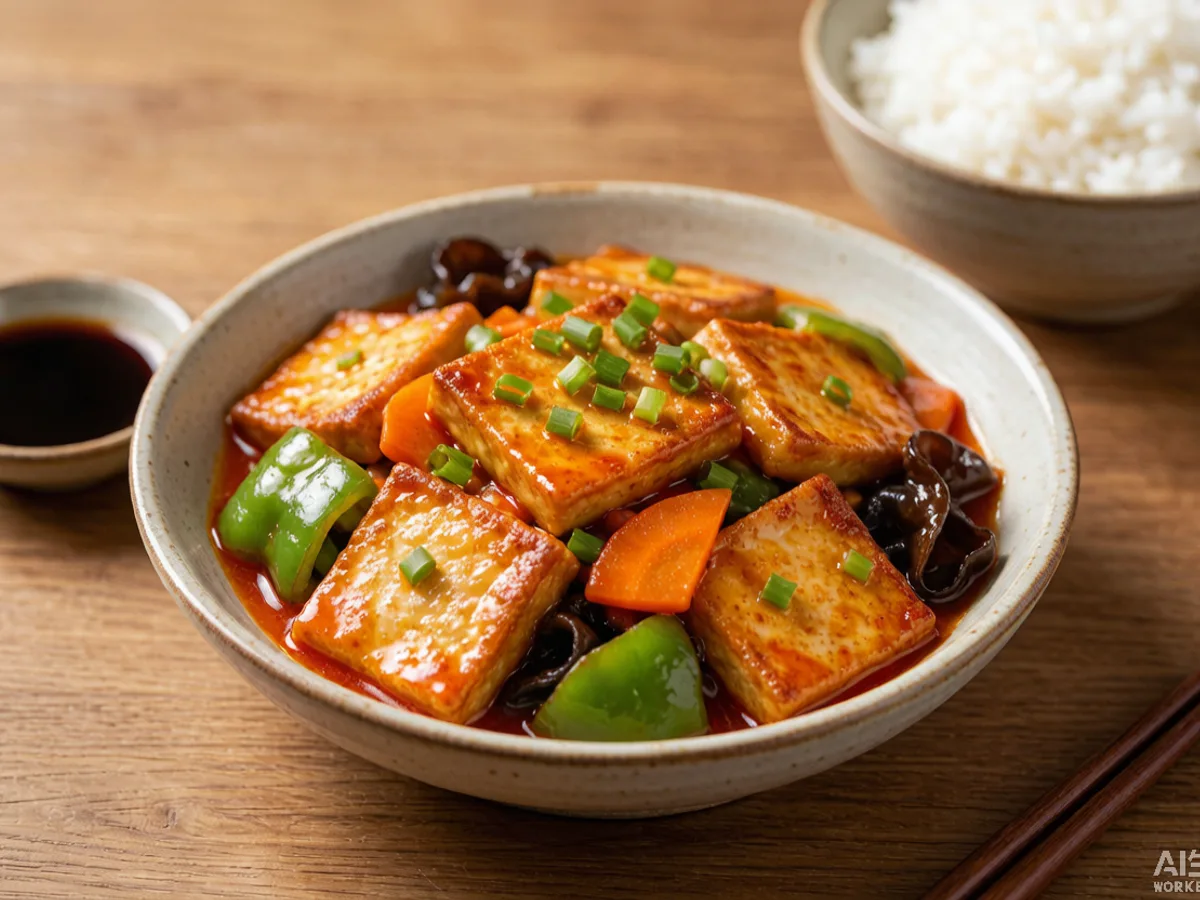
Home-style Tofu (家常豆腐)
家常豆腐 (Home-style Tofu (家常豆腐)) · jiā cháng dòu fu
Moo Shu Tofu (木须豆腐)
木须豆腐 (Moo Shu Tofu (木须豆腐)) · mù xū dòu fu