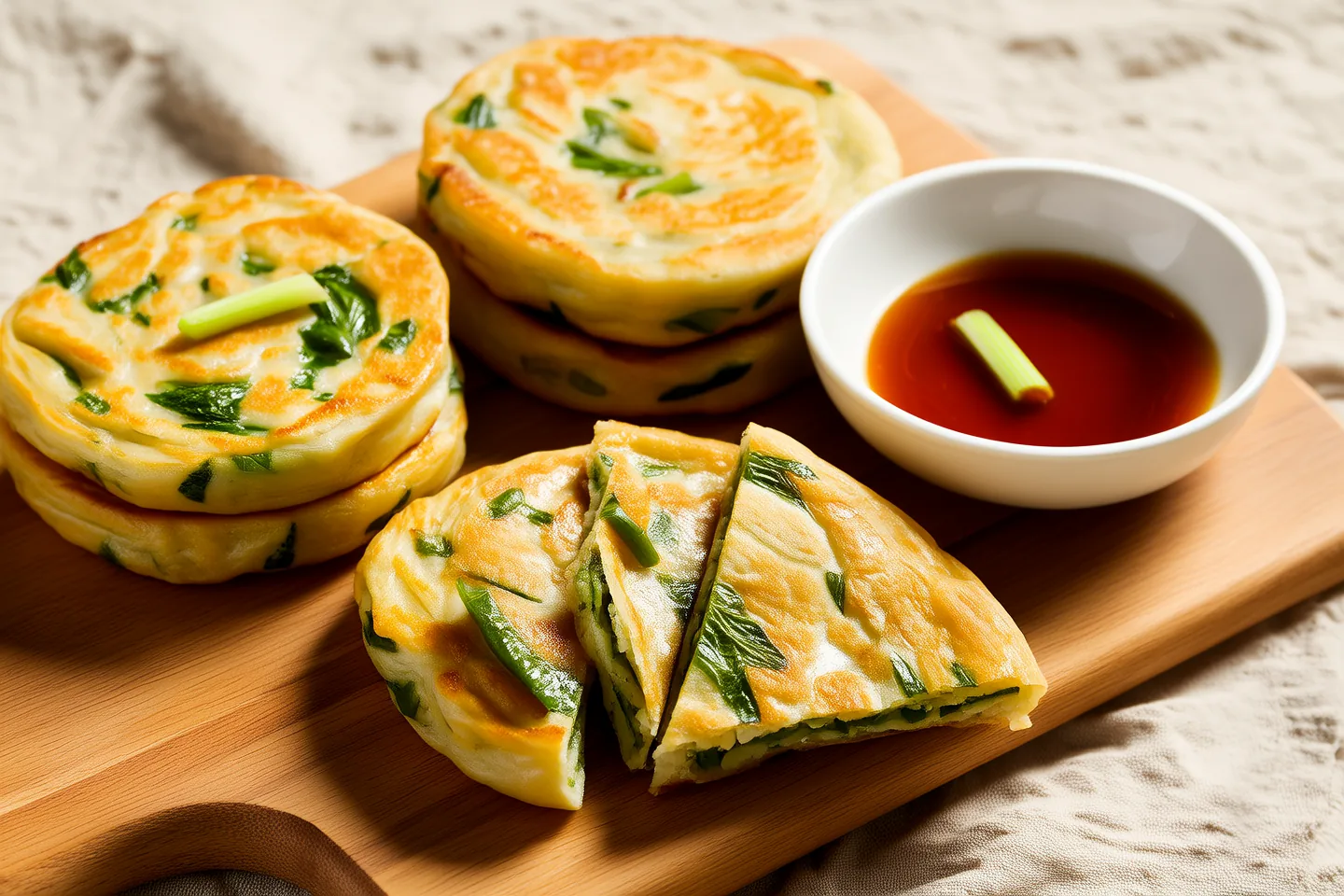
Scallion Flower Rolls
葱油花卷 · cōng yóu huā juǎn
花卷 is mantou's savoury sibling, and the whole difference is one extra step: the dough is rolled flat, oiled, and rolled back up so that steaming separates dozens of paper-thin layers. Any northern Chinese breakfast table runs on these, torn apart along the spiral and eaten alongside congee.
Recipe author: HǎoWèi Test Kitchen
Home-cooking research team
Reviewed by HǎoWèi editorial team · Last updated 2026-08-29
Ingredients
- all-purpose flour中筋面粉🛒 local500 g
- warm water (35°C)温水(35°C)🛒 local270 ml
- active dry yeast干酵母🛒 local5 g
- caster sugar细砂糖🛒 local15 g
- neutral oil, for brushing食用油(刷面用)🛒 local45 ml
- scallions, finely sliced小葱,切细葱花🛒 local90 g
- fine sea salt细海盐🛒 local5 g
- toasted sesame oil (optional)芝麻香油(可选)🏮 asian5 ml
warm water (35°C): Water not milk — the layers stay more distinct without the dairy fat
caster sugar: Just enough to feed the yeast without sweetening the roll
neutral oil, for brushing: The oil is what keeps the layers from fusing in the steamer
scallions, finely sliced: Both white and green parts; dry them thoroughly first
fine sea salt: Sprinkled over the oiled sheet, not into the dough
toasted sesame oil (optional): Brushed on with the neutral oil for depth
🌶️ Adjust to your taste
Pick a level and we'll show exactly how much to change — no more "适量".
Spice level
Saltiness
Oiliness
Make it vegetarian
Instructions
1Proof the yeast with the sugar in the warm water 8 minutes. Add to the flour with the salt, mix to a shaggy mass, then knead 12 minutes until smooth and elastic.
合面揉制
🔍 Look for 12 分钟 · 12 minutesVisual: 面团光滑偏白,能干净脱离案板,能收成光滑圆球Dough is smooth and pale, pulls cleanly off the board and holds a smooth round ball shape
You know it's right when: 抻开能形成透光薄膜而不是破裂A stretched piece forms a translucent windowpane instead of tearing
2Cover and rise at room temperature 75 minutes until doubled.
一发
🔍 Look for 75 分钟 · 75 minutesVisual: 面团高过碗口,表面紧绷微亮Dough domes above the bowl rim with a taut, faintly glossy surface
You know it's right when: 指印保持原状而不回弹A finger indentation stays put rather than springing back
3Roll the dough into a 40 × 30 cm rectangle about 4 mm thick. Brush evenly with the oil (mixed with sesame oil if using), then scatter salt and scallion over the whole surface, leaving a 1 cm border.
擀片刷油撒葱
🔍 Look for 8 分钟 · 8 minutesVisual: 整张薄片都泛着均匀的薄油光,葱花从一头到另一头分布可见The whole sheet glistens with a thin even film of oil, and green scallion is visible edge to edge
You know it's right when: 掀起一角呈半透明的薄片,而不是厚实的面包质感Lifting a corner shows translucent stretched dough rather than a thick bready sheet
Dry the scallions with a towel before slicing. Wet scallion makes the layers steam apart into a soggy mess.
4Starting from a long edge, roll the sheet up tightly into a log. Press the seam closed and roll the log gently to even it out to about 5 cm thick.
卷长条
🔍 Look for 5 分钟 · 5 minutesVisual: 漩涡紧密均匀,层与层之间没有空隙;收口整条捏紧The spiral is tight and even with no gaps between the layers; the seam is sealed along its whole length
You know it's right when: 切面呈现紧密的漩涡纹,放下后不会松开The cut end shows a tight coil, and the log does not unwind when you set it down
5Cut into 10 equal pieces. Stack two pieces, press a chopstick down across the middle to make a deep crease, then lift and pinch the two ends together underneath to form the classic twisted roll.
压痕拧花
🔍 Look for 10 分钟 · 10 minutesVisual: 切面处的层次呈扇形张开,每个花卷都立着可见的分层「花冠」The layers fan open at the cut edges and each roll stands with a visible crown of separated spirals
You know it's right when: 拿起来时压痕保持不散,不会弹回原状The roll keeps the crease when picked up rather than springing back flat
Press firmly with the chopstick and do not worry about flattening it — the layers always reopen in the steamer.
6Arrange on parchment squares, cover loosely and proof 25 minutes. Steam 15 minutes over vigorously boiling water with a cloth-wrapped lid, then rest 5 minutes off the heat before opening.
二发与蒸制
🔍 Look for High heat 醒25分钟 + 蒸15分钟 + 焖5分钟 · 25 minutes proof + 15 minutes steam + 5 minutes restVisual: 花卷饱满洁白,分明的层次之间看得到碧绿葱花Rolls are plump and white with green scallion visible between clearly separated layers
You know it's right when: 顺着漩涡撕开能看到分明的层片,而不是实心组织Pulling one apart along the spiral reveals distinct sheets rather than a solid crumb
Tips
- · Every layer needs oil. Miss a patch and that section fuses into plain dough.
- · Water, not milk, in the dough — the layers separate more cleanly without dairy fat.
- · Re-steam leftovers for 6 minutes; microwaving turns them rubbery in seconds.
Sources & references
Quantities, technique notes, and substitution ratios are cross-checked against established Chinese cookery references and standard food-science sources.
- Read our editorial policy
- Fuchsia Dunlop, Land of Plenty: A Treasury of Authentic Sichuan Cooking
- USDA FoodData Central — ingredient nutrition and portion data
- Traditional Chinese family-kitchen practice and regional taste records
Common questions
Can I reduce the salt/soy in this recipe?
Yes — soy sauce is the main sodium source. Use light soy at 2/3 amount and finish with salt only to taste. Rinse canned/doubanjiang components if possible. Note: reducing soy also reduces color; a drop of dark soy or a pinch of sugar can restore depth without salt.
Source: HǎoWèi diet guide
My dish came out too salty. Can I fix it?
Quick fixes: add a squeeze of lemon/vinegar (acidity masks salt), stir in a few potato chunks or rice (they absorb salt — remove before serving), or bulk it out with more rice/vegetables. Next time: add soy sauce in two stages, taste in the middle, and remember light soy + a pinch of salt is often enough.
Source: HǎoWèi cooking science
🥢 Ask HǎoWèi
Questions about technique, ingredients, substitutions, and flavor — answered from our verified cooking knowledge base.
What to serve with it
A complete Chinese dinner in one plan — pick one from each role.
What cooks say
Made this? Leave a note.
- No comments yet — be the first!